Registration

The RESPORT registration system is the only system in the world to offer real-time, interactive participant lists and maps, as well as integrated carbon offsets for participant travel. Built to scale from hundreds of participants to thousands, the software seamlessly integrates with RESPORT's timing services, results platform, virtual events, and tracking system. Accept online payment for your event in less than ten minutes - with your merchant account or ours.
Other features include web stores tied to your event, sign-up for any kind of event (races, performances, camps, clubs, etc.), accept checks and digital currency, and on-site check-in with QR codes. Custom reports allow data to be displayed or downloaded in any configuration, at any time.
| Type |
Charge from... |
Percent |
Per registrant |
| our merchant account |
ReSport, Inc. |
5.5% |
$0.00 |
your merchant account
Authorize.net, PayPal |
your company name |
you decide
(and keep) |
$1.00 |
Virtual Events
The ReSport platform allows race directors and organizations to create virtual events to replace or supplement postponed or cancelled races, giving participants the event experience online. ReSport supports both virtual races and virtual challenges.
Virtual Challenges give participants the opportunity to achieve a goal. Any kind of goal can be created and tracked, from cycling around a collection of lakes to rowing across the Atlantic Ocean. Rich, interactive maps and charts updated in real time are integral components for every challenge.
Virtual races combine interactive maps, data feeds, imagery, participant information, and social media to simulate the race itself. Participant times and splits are submitted, aggregated, and overlaid on a custom course map and leaderboard. All types of races are supported, from 5k's to multisport, from stage races to team relays.
Strengths of the ReSport platform:
- interactive and custom course maps
- custom markers and participant maps
- individual, team, and overall progress maps
- teams, multiple segments
- dynamic, filterable, sortable leaderboards
- milestones via email and/or SMS
- Strava integration
- on-demand race replays
- white label (your URL and branding)
Google Street View... for bikes!
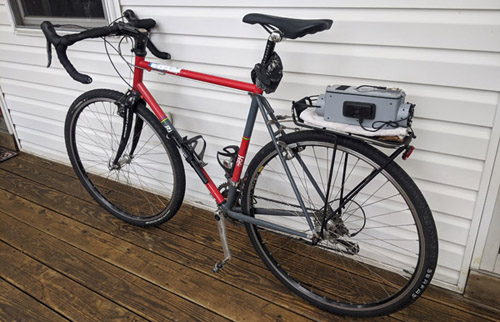
ReSport has developed a system to chart and photograph trails, bike paths, and waterways, much like Google Street View but with a twist: you can watch the mapping process live and in real time - and you can go where cars can't go. Three cameras mounted to the back of a bicycle send a steady stream of photos from the rear and both sides of the bike during the ride.
The photographs become a repository for curious cyclists (or hikers, or boaters) to explore before venturing out. The system was used for the first time during Paulie's Push, a 20-day memorial tribute for the 20th anniversary of 9/11 in which Paulie Veneto walked from Boston's Logan Airport to Ground Zero in New York City while pushing a beverage cart. An interactive map provided real-time updates and pictures along the 200-mile journey.
The system is built from a Raspberry Pi 4 computer connected to Raspberry Pi Zero computers, each connected to a tiny camera. A cell phone battery keeps everything powered and a mobile hotspot provides internet access for uploading the photos and data. While riding through dead spots the photos are saved onboard until connectivity resumes.
The system is now being used to map and photograph bike routes and trails throughout the world, with the possibility of creating the world's largest panorama by stitching the photographs together.
Results and Replays
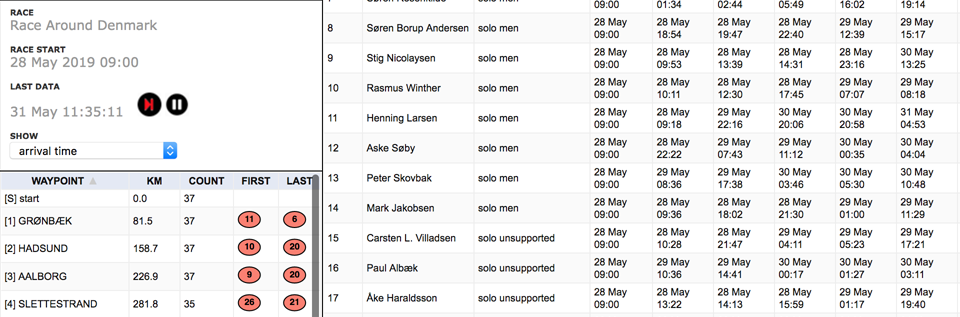
RESPORT can take existing timing data and display it in three dimensions. Our software creates immersive interactive maps, both live (during the race) and afterwards as a replay.
Raw data can come off the timing system during the race or after the race from a text file. With just a GPX file and a CSV file, in two minutes RESPORT can build an online, interactive visualization of any race. Your existing data archive immediately adds value to events, sponsors, and participants. Race directors will appreciate the story that a map can tell about race flow, and sponsors will like the stickiness of your online results.
Results/scoring example: Atlanta 2020 Olympic Marathon Trials
Race replay example: The Seneca7 2019
Interactive Maps
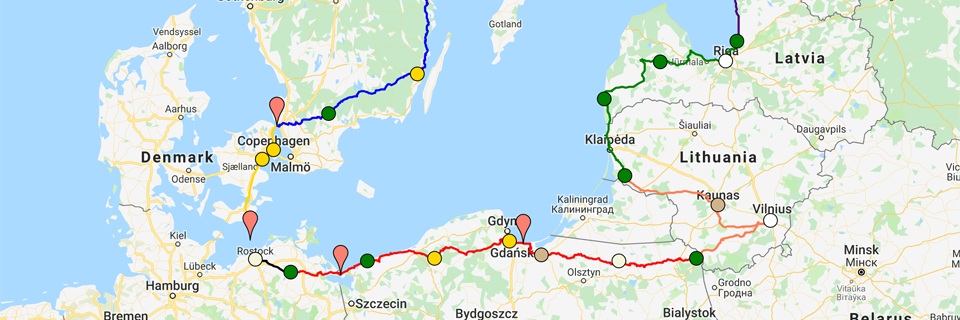
RESPORT software creates interactive, immersive digital maps. From the comfort of a web browser, create and edit maps of races, tours, trips, and event sites. Features include multiple courses on the same map, labeled markers, elevation profiles, GPX import and export, and "you are here" interactivity.
Each mobile-friendly map (including unlimited courses, markers, and elevation profiles) fits neatly on a single webpage, with no ads or other distractions. The maps can be embedded in your website and customized to complement your event design. Further, a collection of maps can be displayed on a map set to show, for example, a race series or a collection of trips.
Map example: Race Around Denmark
Race Tracking

RESPORT software lets spectators, officials, and race directors monitor the progress of athletes. Live updates throughout the race show the position of participants in real-time, while replays can guide event planning for the next edition.
While a race is in progress, RESPORT software accepts location data from a timing system, satellite tracker, or manual entry. These positions are plotted on a map and updated in real-time, without the need for a browser refresh. At the same time, SMS notifications provide location and pace information as the race unfolds - sent to those watching on-site or anywhere in the world.
Want to know when the first swimmer comes out of the water during a triathlon? When your favorite runner reaches the halfway point of a marathon? RESPORT gives you that information.
Contact Us
 RESPORT makes software to bring races alive. From interactive registration and maps to live race viewers to immersive results and replays, we build systems to make your race experience better - whether you're an athlete, race director, spectator, timing company, or sponsor. Let us know how we can be part of your next event.
About this privacy policy
This privacy policy has been compiled to better serve those who are concerned with how their personal information is being used online. "Personal information" is information that can be used on its own or with other information to identify, contact, or locate a single person, or to identify an individual in context. Please read this privacy policy carefully to get a clear understanding of how we collect, use, protect or otherwise handle your personal information in accordance with our website.
We may periodically update this policy. We will notify you about significant changes in the way we treat personal information by sending a notice to the primary email address specified when you signed up for an event, or when you created an event as an event director. It is strongly recommended that you check this page periodically when you visit our website, referring to the date of the last time we modified the policy (on the bottom of this page).
What personal information do we collect from the people that visit our website and application?
We don't automatically collect personal information when you visit our website. When you submit a form requesting more information, we collect name and email address so we can respond to your inquiry.
As a ReSport customer (i.e., someone who wants to participate in an event on our platform or someone who wants to enable registration for an event) you will be asked for personal information to facilitate the participation in or management of that event. If the event has an entry fee, you may also be asked to provide additional personal information in the form of billing information (e.g., credit card number, billing address, expiration date, card security code). You will only be asked to provide this information if the event requires a fee in order to participate. We do not store your credit card information on our servers, and instead use a third-party service (Authorize.net or PayPal) as a secure, PCI-compliant credit card processor.
What personal information do we collect automatically?
We collect your IP address when you access our website and it is stored in our server logs for no longer than 30 days. There is no additional personal information that is collected automatically. We do not record/store your IP address in a database, nor is it ever directly associated with any other personal information. This information is only used to help monitor and resolve technical issues.
When do we collect or process personal information?
We collect or process information from you when you register for an event on our site, fill out a form (e.g., when registering or creating an event) or enter information on our site (e.g., when registering for an event or when creating an event).
Why do we collect or process personal information?
Personal information is necessary to create a record of your participation in an event and to enable you to pay for an event that charges an entry fee. Without the ability to collect the personal information outlined above, our website would be unable to fulfill its intended purpose (i.e., to facilitate participation in an event).
How do we use your personal information?
We may use the information we collect from you when you sign up for an event or interact with the event, such as in the following ways:
- To send a confirmation email or receipt stating that you have registered for the event.
- To send an instructional email describing how to participate in the event.
- To display charts, graphs, or maps showing your participation in the event.
- To process credit card payment for the entry fee of the event you have signed up for.
- To manage your participation in the event.
How can you update or delete your personal information?
If you ever want us to update or delete the information associated with you, please email us at info@resport.io and we will do so within 14 days of the initial request.
How long is your personal information retained?
Your personal information is retained in our system for a period of 2 years unless you request its deletion earlier than that.
How is your personal information secured?
The ReSport software is hosted on Google App Engine, a service of Google. More information about the Google privacy policies can be found at https://policies.google.com/privacy
If you register for an event using your credit card, your personal information is transmitted to Authorize.net or PayPal for the processing of the credit card (depending on the preference of the event director). More information about the Authorize.net privacy policy can be found here: https://www.authorize.net/about-us/privacy.html
More information about PayPal's privacy policy can be found here: https://www.paypal.com/us/webapps/mpp/ua/privacy-full
All personal information transferred to and from ReSport is secured by end-to-end 128 bit SSL connections.
Where is your personal information processed/stored?
ReSport is located in the United States, and most/all of the third party services we use store/process data in the United States as well. As such, the personal information you share on this site may be transferred to countries other than the one in which you live. Please see the list of third-party providers in this Privacy Policy (below) for a complete list of these providers.
Who from the ReSport organization will have access to your personal information?
Selected ReSport staff that have a clear justification for accessing personal information will only access your account information to provide technical or administrative support, and to the least extent needed to solve a technical or administrative issue. We will not disseminate or share data other than you have directed, in accordance with the policies outlined in this Privacy Policy and our Terms of Service. All staff members and/or contractors have signed non-disclosure and confidentiality agreements, and have been instructed on how to handle personal information to comply with relevant guidelines and regulations.
The organizer of the event you have registered for also has access to your personal information for the purpose of administering the event.
Is my personal information ever sold or rented to a third party?
No. ReSport does not sell or rent participant information to any third-party advertisers or marketers. ReSport provides a platform for online event registration in exchange for software access fees paid by event directors or participants, and as such does not have a business model that relies on selling the personal data of our users to third parties. Your personal information is only shared with third parties for the purposes of providing the services as outlined in this Privacy Policy.
Is my personal information ever shared with a third party?
We may share selected personal information with third-party service providers who assist us in operating our website, conducting our business, or servicing you, so long as those parties agree to keep this information confidential. We may also release your information when we believe release is appropriate to comply with the law, enforce our site policies, or protect ours or others' rights, property, or safety.
Which third parties may receive my personal information in order to provide this service?
Below is a list of the specific third parties that we use to assist us with providing services to you, along with the purpose(s) for which we may share your personal information with these third parties and the specific personal information that is shared with these services.
- Google App Engine (https://cloud.google.com/appengine) - Google App Engine is a product of Google and provides a cloud platform where we host the ReSport applications and database. Since it is our hosting and database provider, all personal information shared on the ReSport site is hosted at Google App Engine. Processing of data on Google App Engine happens in the United States.
- PayPal (https://paypal.com) - PayPal is used by some events to provide credit card processing for participants registering for an event online. The personal information shared with PayPal includes your name, email address and billing information (note that billing information is not stored on our server - when entered on our site it is transferred directly to PayPal). Processing of data on PayPal happens in the United States.
- Google Analytics (https://google.com/analytics) - Google Analytics is a web analysis service provided by Google Inc. ReSport uses this service to monitor and analyze the use of the service. Google uses the data collected to track and examine the use of this application, prepare reports on its activities and share them with other Google services. Google may also use the data collected to contextualize and personalize the ads of its own advertising network. Processing of data on Google Analytics happens in the United States. Note that if you wish to opt-out of Google Analytics tracking on this website, please visit this page: https://tools.google.com/dlpage/gaoptout
- Mailgun (https://mailgun.com) - Mailgun is a transactional email sending service. We use Mailgun to send "transactional" confirmation, receipt, and instructional emails to participants who register for events on our site. We also use Mailgun to send summary emails to event directors when someone registers for their event(s), if they choose that service. Personal data sent to Mailgun may include your first name, last name and email address. Processing of personal data on Mailgun happens in the United States.
- Telnyx (https://telnyx.com) - Telnyx is a service for sending SMS messages to a phone number. We use Telnyx to send short messages to event directors when someone signs up for an event, if the event director chooses. Personal data sent to Telnyx may include your first name and last name. Processing of personal data on Telnyx happens in the United States.
What means do I have to limit the use and disclosure of my personal data?
Individuals may have the right to limit the use and disclosure of their personal information, such as whether your personal information is disclosed to a third party or used for purposes materially different from the purpose for which the personal information was originally collected or subsequently authorized by you. If you wish to limit the use and disclosure of personal information, please contact us at info@resport.io.
Will you encounter third-party links on our website?
We do not include or offer third party products or services directly on our website. However, each event is run independently by event directors (customers of ReSport) that are not be directly affiliated with ReSport. In these events you may be solicited with offers for third-party products or services, which ReSport will not be aware of. ReSport does not endorse these third-party products and services not directly run by ReSport.
Do we use 'cookies' on the ReSport website?
Yes. Please click this link to view our Cookie Policy.
How does our site handle do not track signals?
We don't honor do not track signals and do not track, plant cookies, or use advertising when a Do Not Track (DNT) browser mechanism is in place. We don't honor them because:
- Capabilities do not currently exist to track signals.
COPPA (Children Online Privacy Protection Act)
When it comes to the collection of personal information from children under 13, the Children's Online Privacy Protection Act (COPPA) puts parents in control. The Federal Trade Commission, the nation's consumer protection agency, enforces the COPPA Rule, which spells out what operators of websites and online services must do to protect children's privacy and safety online.
We do not specifically market to children under 13.
CAN-SPAM Act
The CAN-SPAM Act is a law that sets the rules for commercial email, establishes requirements for commercial messages, gives recipients the right to have emails stopped from being sent to them, and spells out tough penalties for violations.
We collect your email address in order to:
- Send information related to your participation in an event you have registered for, and/or request information to assist in the administration of the event you have registered for.
To be in accordance with CANSPAM we agree to the following:
- NOT use false, or misleading subjects or email addresses.
- Identify the message as an advertisement in some reasonable way.
- Include the physical address of our business or site headquarters.
- Monitor third party email marketing services for compliance, if one is used.
- Honor opt-out/unsubscribe requests quickly.
- Allow users to unsubscribe by using the link at the bottom of each email.
If at any time you would like to unsubscribe from receiving future emails, you can:
- Follow the instructions at the bottom of each email; or
- Email us at info@resport.io
How can you contact ReSport?
If there are any questions regarding this privacy policy you may contact us by mail or email using the information below:
ReSport, Inc.
260 East Main Street, Suite #6345
Rochester, NY 14604
info@resport.io
Updated June 5, 2020
What is a 'cookie'?
Cookies are small files that a site or its service provider transfers to your computer's hard drive through your Web browser (if you allow) that enables the site's or service provider's systems to recognize your browser and capture and remember certain information.
Do we use 'cookies' on the ReSport website?
Yes. The ReSport website uses cookies to remember and process the information you (as an event director) manage in the events you administer. We also use cookies to help us compile aggregate data about site traffic and site interaction so that we can offer better site experiences and tools in the future.
Why do we use cookies?
We use cookies to:
- Remember that you are logged in (if you are an event director) and that your session is secure. You need to be logged in in order to create or manage your events on this website.
- Compile aggregate data about site traffic and site interactions in order to offer better site experiences and tools in the future. We use a third-party service (Google Analytics) to track this information on our behalf.
Note that we do NOT use cookies for advertising or ad targeting purposes, as this website does not rely on or use advertisements.
How can you block cookies?
You can choose to have your computer warn you each time a cookie is being sent, or you can choose to turn off all cookies. You do this through the settings on your web browser. Each browser is a little different, so please refer to your browser's Help menu to learn the correct way to modify or block cookies.
What happens if you block cookies?
If you disable cookies, you will not be able to log in to the site as an event director. You will not be able to manage or create events which allow someone to register for your event.
Who can I contact if I have questions about how cookies are used on the ReSport website?
If there are any questions regarding this Cookie Policy you may contact us using the information below:
ReSport, Inc.
260 East Main Street, Suite #6345
Rochester, NY 14604
info@resport.io
Last edited on June 16, 2020
Elements
Text
This is bold and this is strong. This is italic and this is emphasized.
This is superscript text and this is subscript text.
This is underlined and this is code: for (;;) { ... }. Finally, this is a link.
Heading Level 2
Heading Level 3
Heading Level 4
Heading Level 5
Heading Level 6
Blockquote
Fringilla nisl. Donec accumsan interdum nisi, quis tincidunt felis sagittis eget tempus euismod. Vestibulum ante ipsum primis in faucibus vestibulum. Blandit adipiscing eu felis iaculis volutpat ac adipiscing accumsan faucibus. Vestibulum ante ipsum primis in faucibus lorem ipsum dolor sit amet nullam adipiscing eu felis.
Preformatted
i = 0;

while (!deck.isInOrder()) {
    print 'Iteration ' + i;
    deck.shuffle();
    i++;
}

print 'It took ' + i + ' iterations to sort the deck.';
Lists
Unordered
- Dolor pulvinar etiam.
- Sagittis adipiscing.
- Felis enim feugiat.
Alternate
- Dolor pulvinar etiam.
- Sagittis adipiscing.
- Felis enim feugiat.
Ordered
- Dolor pulvinar etiam.
- Etiam vel felis viverra.
- Felis enim feugiat.
- Dolor pulvinar etiam.
- Etiam vel felis lorem.
- Felis enim et feugiat.
Icons
Actions
Table
Default
| Name |
Description |
Price |
| Item One |
Ante turpis integer aliquet porttitor. |
29.99 |
| Item Two |
Vis ac commodo adipiscing arcu aliquet. |
19.99 |
| Item Three |
Morbi faucibus arcu accumsan lorem. |
29.99 |
| Item Four |
Vitae integer tempus condimentum. |
19.99 |
| Item Five |
Ante turpis integer aliquet porttitor. |
29.99 |
|
100.00 |
Alternate
| Name |
Description |
Price |
| Item One |
Ante turpis integer aliquet porttitor. |
29.99 |
| Item Two |
Vis ac commodo adipiscing arcu aliquet. |
19.99 |
| Item Three |
Morbi faucibus arcu accumsan lorem. |
29.99 |
| Item Four |
Vitae integer tempus condimentum. |
19.99 |
| Item Five |
Ante turpis integer aliquet porttitor. |
29.99 |
|
100.00 |